
In Closing

There was a time when I thought I would never see a Ruffed Grouse. For nearly 20 years of birding, these little crested forest chickens were my nemesis bird. I scoured the right habitats, yet always missed. In September, 2024, I finally ran across one when I wasn’t even looking (I had long given up on searching for them). Alex and I came upon a brown, football-shaped lump in the middle of a western Montana Forest Service Road. “Is that a grouse?” I asked, and she stopped the car. I looked through binoculars, and before the dust settled, I had seen my lifer.
I still hadn’t found one in Utah, though. If I was going to get one in my home state, why not in Carbon County? I tried Scofield Reservoir, and the nearby Fish Creek road where they had been reported in the past, but after numerous attempts, I didn’t find one. I searched great grouse habitat at the end of Consumer’s Road. I looked for over a year, recalling the single bird I had seen in Montana. It felt like my nemesis bird was now just my Utah nemesis.
On December 19th, 2025, I was having trouble coming up with a place to go birding. I had just seen my 202nd species of the year, a Chestnut-sided Warbler, and I thought that would be the last new bird I would get before the calendar rolled over to 2026. I decided to look for something I had already seen, but not for a while. Black-capped Chickadees are one of my favorites. They are widespread throughout Utah, but are curiously scarce in Carbon County. I knew of one spot where I could reliably find them every summer. I had already located a pair in 2025, in a stand of Gambel oak and Aspen on Consumer’s Road, just after the pavement turns to gravel. Since we have had almost no snow this year, I decided to check and see if the chickadees hung around in the winter.
I parked my truck in a pullout just as the blacktop ends. The road hadn’t been plowed beyond, and I didn’t know how deep the snow would get. I wanted to walk a couple miles anyway. The thick forest at the end of the asphalt is in perpetual shadow when the winter sun is low in the sky, so it was cold. A light condensation had frozen on the bare aspen branches, and when a breeze blew and broke the ice, the whole forest tinkled like it was full of millions of miniature bells.
I walked up the hill, and slipped where the snow had been compacted by truck tires. To get more traction, I tried the spots that had been worn down to gravel, or, if that wasn’t possible, on the shoulder of the road. I didn’t think much about footwear when I left the house. I was wearing sneakers, so after a bit of walking through the crunchy snow at the road’s edge, my socks started to get wet. My feet got cold, so I looked ahead and marked a flat spot where I would turn around and head back to the truck.
I reached my turnaround spot, and saw movement coming from the forest floor. I spooked a Ruffed Grouse, and it was walking away slowly. It was headed uphill, and extended its neck longer than I thought possible, perhaps to get a better view of me. It walked away at a steady pace, soon blending into the leaf litter. I had seen my first Utah Ruffed Grouse in Carbon County.
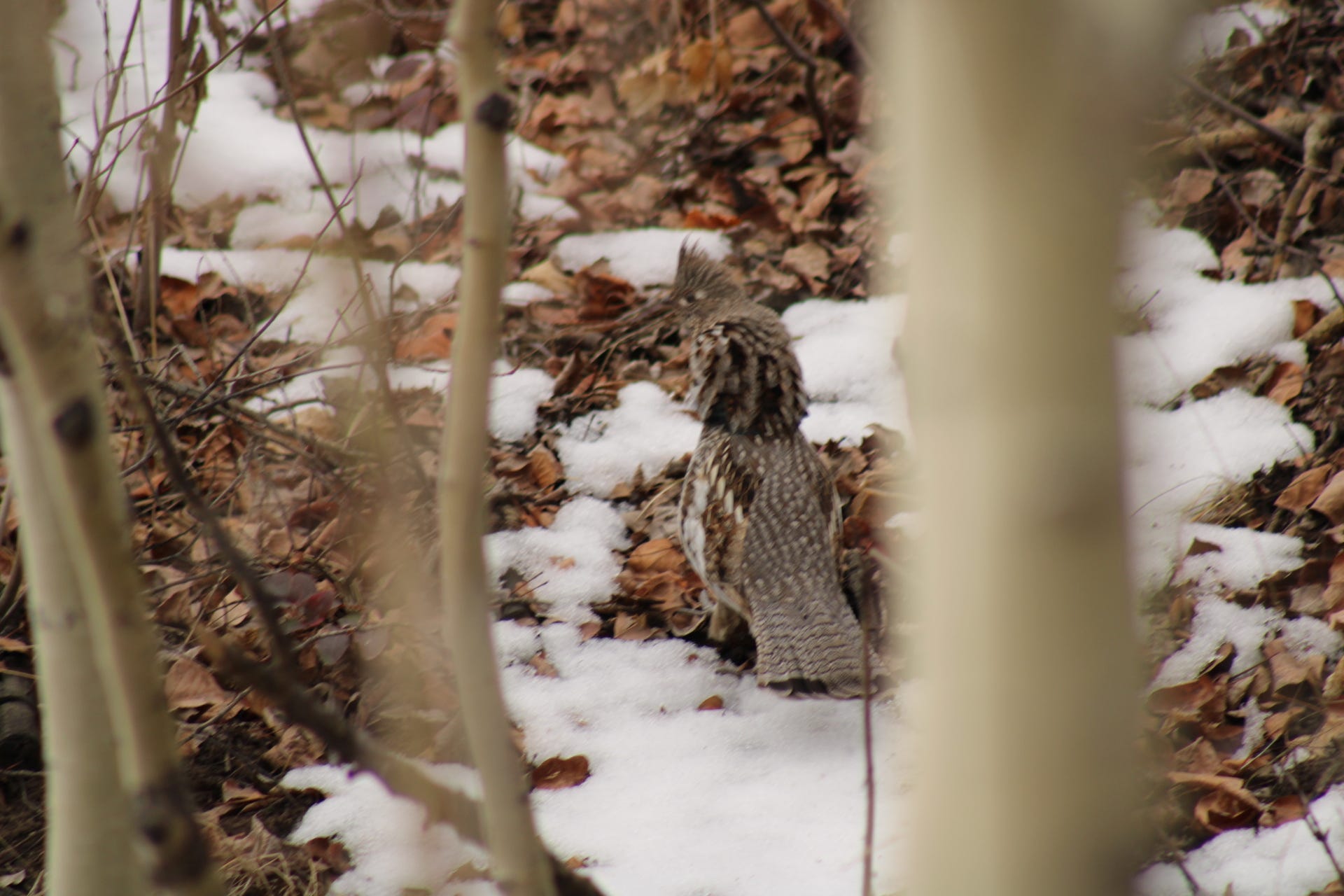
I turned around and walked down the hill, no longer caring if I saw Black-capped Chickadees. In the steep spots, I let myself slide down the ice. I didn’t have to walk in the snow on the way back, since traction wasn’t important as long as I kept my balance. I stepped off the road to take a piss, so I could be shielded in the unlikely event that someone drove by. I heard a clucking noise coming from the forest floor below some Gambel oak. I looked, and there was another Ruffed Grouse. This one was a bit farther from me, and moved quickly away. I was able to take a photo before it got far enough that it blended in, and I lost it. I couldn’t believe that after all the searching I had done over the years, and all the coming up short, I had just seen two Ruffed Grouse in one day.
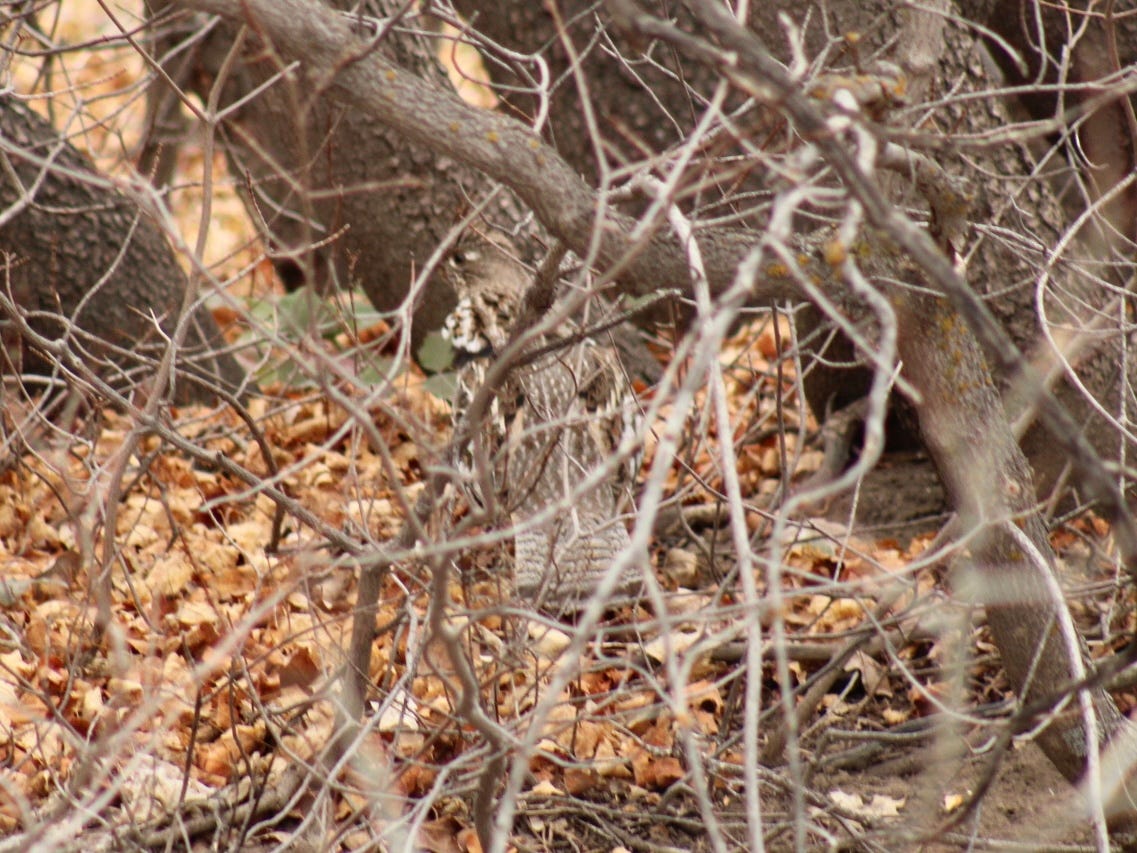
After relieving myself, I continued my return journey. As I was getting close to my truck, I heard the call of chickadees coming from the side of the road. I pished, and called in three Black-capped, and a single Mountain Chickadee. I watched them for a moment, before they lost interest in the noises I was making, and flitted off. I looked down towards my feet, and close enough that I could have reached out and nudged it with my shoe, was a third Ruffed Grouse. I took a few preliminary photos, but there was a fallen branch right in the way. I softly stepped to my right, so I could get an unobstructed view, and a better picture. The grouse didn’t move, and let me photograph it for a moment. When it decided to leave, it seemed more sick of me than scared of me. It walked off slowly, and I left it alone. I turned and resumed my trip back to the warm truck.
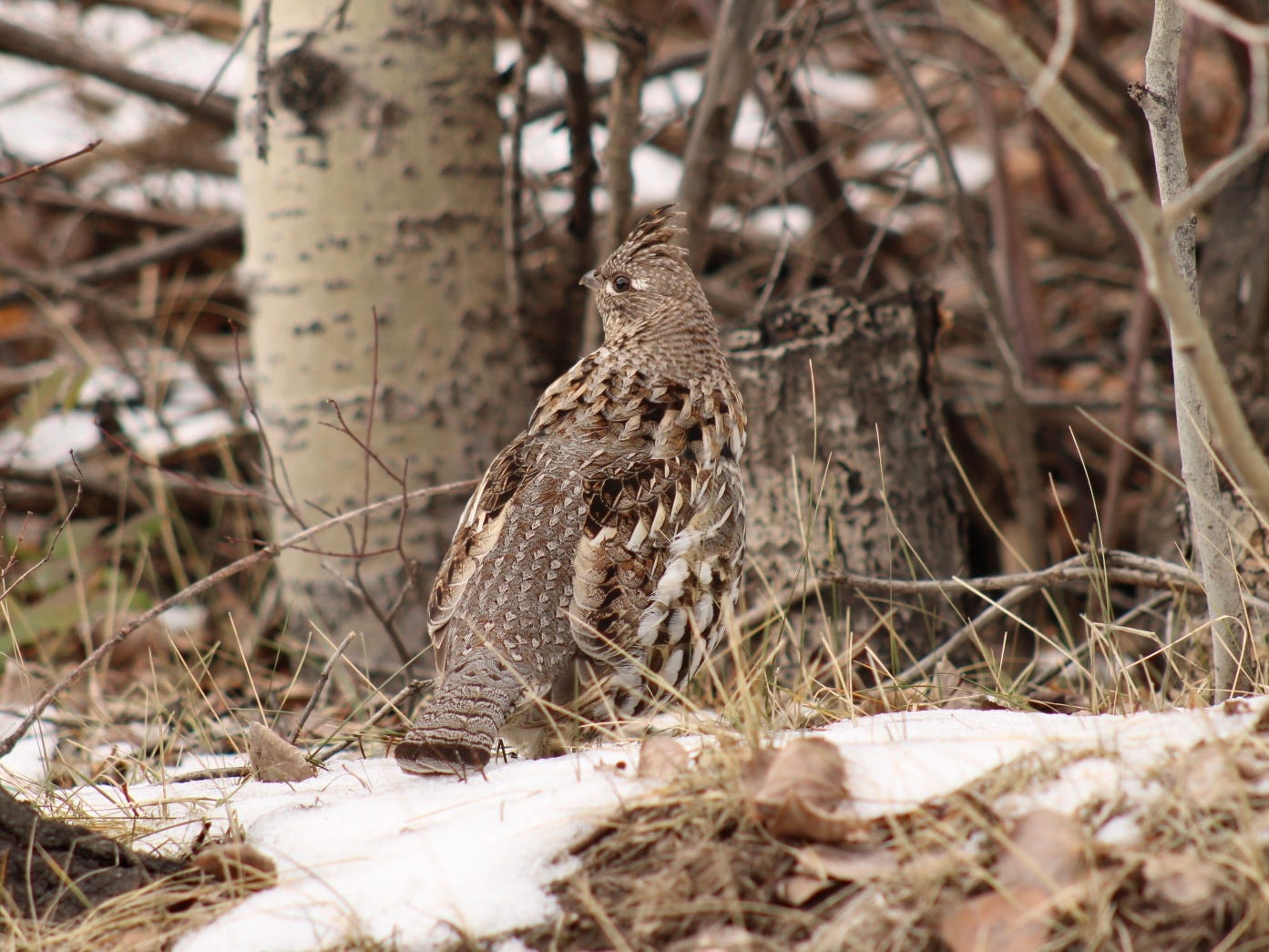
These were the best looks I could have ever hoped for. Grouse aren’t beautifully colored like songbirds; their grays, browns, blacks and whites blend in perfectly with their habitat. What they lack in color, they make up for in geometric beauty. This species is remarkably patterned, and I believe, one of the most visually pleasing birds out there. I was surprised how quickly I lost sight of them when they walked away from me.
These three grouse would be my 203rd Carbon County species, the last of the year where my goal was to see 200. It was hard to top my second to last, the Chestnut-sided Warbler, but this was up there. Even though Ruffed Grouse are common breeders in Utah, I found December 19th to be one of the best days of birding I had in 2025. It was a perfect end.
What a spectacular end to the year! Ever since I read your essay about searching for your first ruffed grouse, I think of you when I see one in Northern Wisconsin. I never seek them out, but I do seem to have a knack for startling them in the underbrush when I'm hiking!